advertisement
The following post is from Melissa of The Cork Board
advertisement
This post contains affiliate links.
Not just about reading the classics in Latin and Greek.
When I thumb through classical education curriculum catalogs, I often get the impression that classical education is all about studying ancient texts and civilizations. In fact, classical education is a method of teaching anything in three stages–grammar, logic, and rhetoric. Conveniently, these three learning stages can also align with a child’s developmental development. To read more about what classical education is really all about, click here.
Community not a co-op.
Local Classical Conversations (CC) communities meet weekly. While parents must remain onsite, they are not required to teach. Parents who desire to teach are referred to as tutors, trained annually, and receive monetary compensation. Additionally, the students are divided generally by age into classes, but all classes cover the same material each week. This homogeneity of content in CC makes teaching multiple ages and stages more feasible.
Complete curriculum.
Other than a phonics (or learn-to-read) and a level-appropriate math curriculum, CC provides everything a family needs to experience a rigorous, well-rounded education. Many families treat it as a supplement which often results in not receiving the full benefit of a classical education or feeling overwhelmed at not being able to “do it all.”
I highly recommend Leigh Bortin’s book, The Core , as a practical guide for getting the most out of a CC community and education. I love the simplicity and space for allowing kids to be kids while developing them into voracious learners.
Can be affordable.
Because CC is structured differently than a traditional co-op, the tuition often creates sticker shock. However, when you consider that there are very few consumables or additional curriculum to purchase, CC tuition can be comparable to purchasing curriculum materials.
Additionally, because tutors are compensated, parents can earn back their tuition by working in their community. My job tutoring of Essentials this year is paying for 6 kids in Foundations and 4 in Essentials.
Adaptable for all learning styles and special needs.
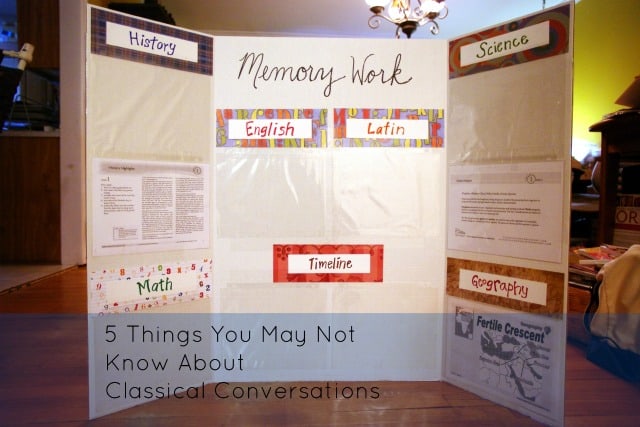
Memory work can be practiced visually, audibly, and kinesthetically. Because the parents are honored as the teachers, CC generally allows parents to make the best decision for their students. That means that I can have my teens in Foundations and Essentials, since that is where their skill level currently falls. It also means you can scale any part of CC to meet your family’s needs. Foundations is a lot about reading good books and memorizing material. Everyone, no matter their cognitive ability, can participate in those activities.
During community time, no one is policing how well you are memorizing your material (especially if there is a known special consideration). However, tutors can certainly offer accountability where appropriate.
I have an academically gifted child, an average learner, a child with mild special needs who is also delayed, and three who are non-native English speakers. CC is meeting everyone’s needs right now. We have also participated in a community with a Down’s Syndrome child whose mother said, in over a decade, CC was the only homeschool curriculum and community environment her daughter learned and thrived in.
To find out more about Classical Conversations which offers programs for children 4 years old through college, visit www.classicalconversations.com.
 |
Melissa is a photography-dabbling, primal-eating, housework-hating, triathlon-trying, black belt-seeking, grace-needing mom to 6 kids ages 7 to 15. She tutors for her local Classical Conversations Community in MD. Passionate about orphan and widow care, her family co-founded The Grafted. She blogs about adoption, Classical Conversations, and life at The Cork Board. You can keep up with Melissa on Facebook, Pinterest, Flickr and Twitter. |
Join 40,000+ Other Awesome People
Subscribe to the Real Life at Home weekly newsletter to get our latest content, exclusive free printables, learning activities, and ideas for celebrating with your kids all year

This is our 1st year in CC. This is the best summary I’ve seen for explaining it to our friends and family. Thank you!
Welcome!
Short, sweet, and right on. Thanks for sharing!
This is great – thank you!
But I was wondering how tutoring pays for all your children to do CC? I tutored a Master’s class of nine kids last year and it only covered one of my children’s tuition (including curriculum, facilities fee, supplies fee, registration fee etc.).
I still think it is a good value if you break it down by week, but there are a number of larger families in our wider homeschool community that are unable to make CC work financially – even with tutoring.
I was wondering the same thing…how can tutoring Essentials cover 6 kids’ tuition? I come out a teeny bit ahead not counting materials for 2 kids by tutoring Foundations.
Vickie,
I was tutoring a full to overflowing Essentials class…17 students, I think. Because we got paid on commission, I had enough to cover 6 kids in Foundations with 1 or 2 of those in Essentials.
However, our family is no longer with Classical Conversations.
http://www.thecorkums.com/2015/06/10/why-cc-is-on-probation-for-our-family/
Instead, we started a new community called Bridges (www.bridgesclassicalcommunity.com)